
Native American History
Overview
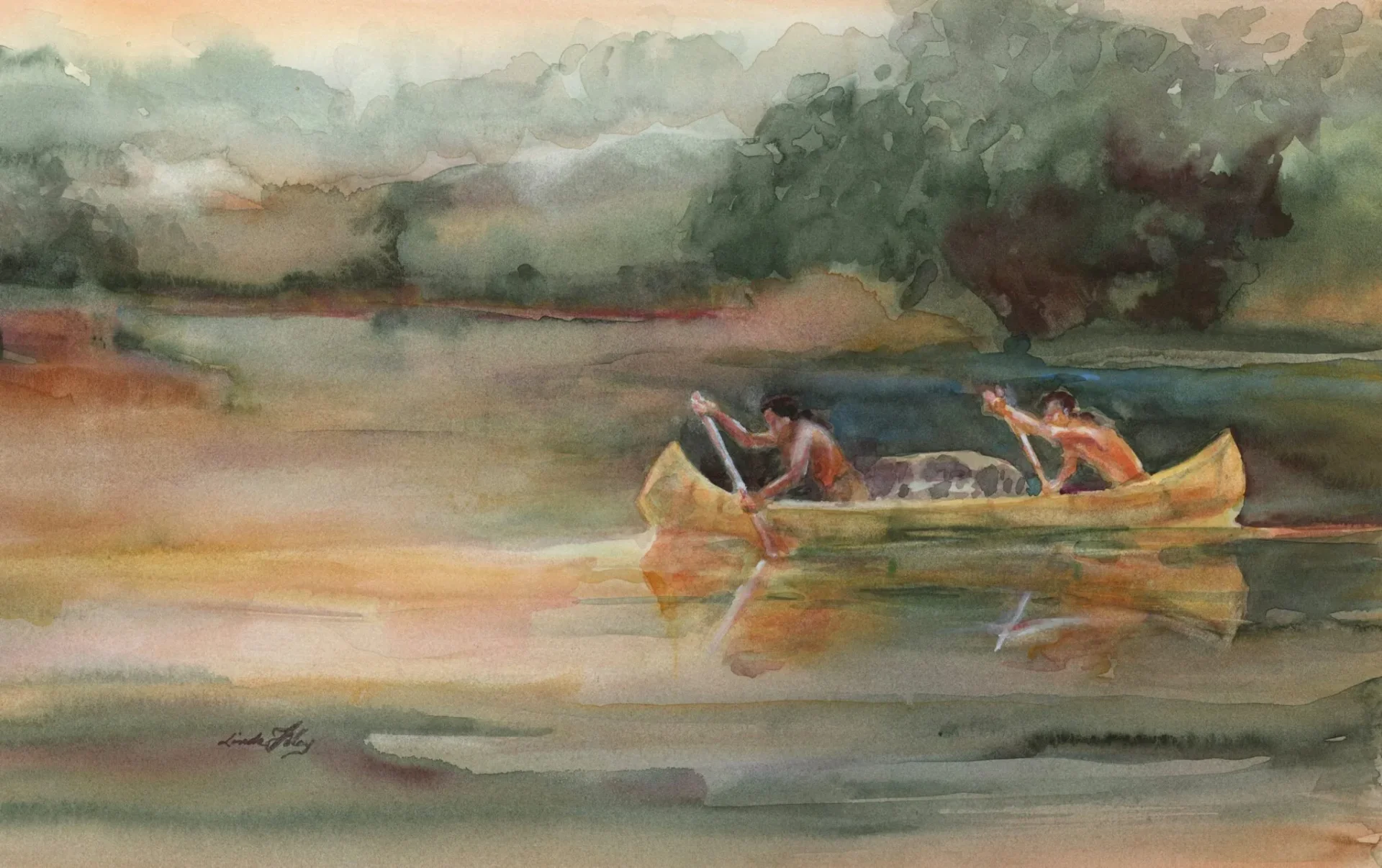
Long before European settlers arrived, the eastern shore of Lake Michigan, including what is now known as Ottawa County, Michigan, was home to thriving Native American communities. These Indigenous peoples, part of a larger cultural group known as the Anishinaabek, lived in harmony with the land. Often referred to as Woodland Indians due to the forested environment in which they lived, they sustained themselves through hunting, fishing, gathering wild rice, and cultivating small crops.
The Anishinaabek Way of Life Before European Contact
The Anishinaabek originally migrated from the northeastern part of North America to the Great Lakes region. By the 1500s, they had divided into three main tribes: the Ottawa, the Ojibwa (also known as the Chippewa), and the Potawatomi. Together, these tribes formed a powerful alliance known as the Three Fires Confederacy. By the 1700s and early 1800s, the Ottawa had established many villages along the eastern shore of Lake Michigan and throughout the Grand River Valley, with several settlements already in place by 1740. The Potawatomi settled around the southern part of Lake Michigan and into what is now Wisconsin. At the same time, the Ojibwa lived in the northeastern Lower Peninsula and much of the Upper Peninsula. Although each tribe spoke a different dialect, they shared a common language, Anishinaabemowin, which is part of the Algonquian language family.
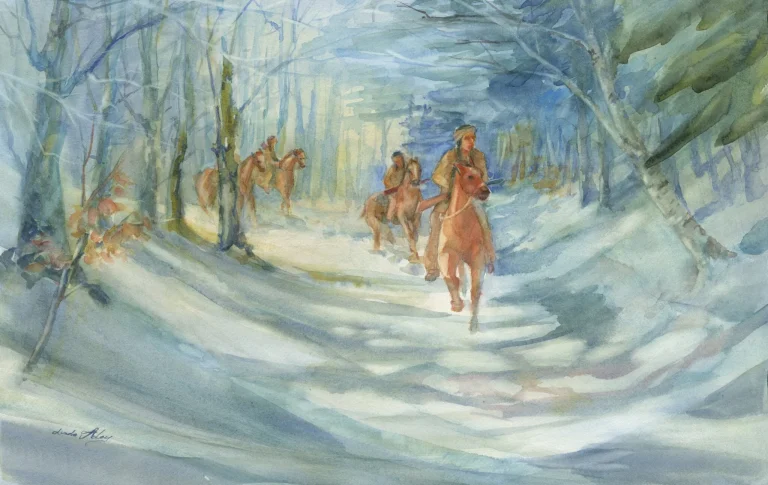
These Native American communities migrated with the seasons to take advantage of more favorable hunting, fishing, and farming grounds. In winter, many traveled south to trap and fish, relying on the land’s resources for survival. A combination of seasonal mobility and subsistence activities shaped their diet and lifestyle. When the French arrived, a fur trading system quickly developed between the newcomers and the Native American tribes. This relationship became so strong and strategic that during the French and Indian War (beginning in 1754), the Ottawa, Potawatomi, and Ojibwa sided with the French. However, the relationship between Native American communities and settlers began to shift dramatically in the 19th century.
Treaties, Land Loss, and Forced Relocation
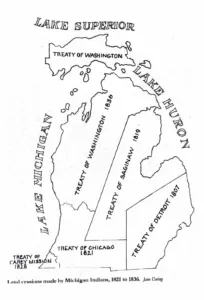
Between 1825 and 1858, West Michigan underwent significant changes as white settlers moved into the region in increasing numbers. This migration was largely driven by the opening of the Erie Canal, which made West Michigan more accessible. To make room for settlers, Governor Lewis Cass pushed for the forced cession of Native American lands throughout Michigan.
The Treaty of Washington in 1836 marked a significant turning point. Under its terms, the Ottawa (Odawa) were pressured into ceding all land north of the Grand River to the United States. This land transfer was considered essential for the Michigan Territory to qualify for statehood. The Potawatomi had already given up land south of the Grand River in the Treaty of Chicago in 1821. Additional treaties were signed in the years following 1836, primarily aimed at addressing flaws in earlier agreements. In exchange for their land, Native American communities were promised goods, annual payments (known as annuities), and new land locations that would later become formal reservations. By the time of the Treaty of 1855, conditions had worsened for Native American communities. Access to natural resources had diminished, and pressure from settlers continued to grow. Between 1857 and 1858, about 13,000 Native people from 17 bands left their traditional villages along the Grand River and were relocated to the Grand Haven Area.
Resilience, Cultural Legacy, and What Remains Today
In the summer of 1857, many families boarded a steamboat called The Ottawa and traveled north to Pentwater. From there, they were moved to newly created reservations in Elbridge and Crystal Townships (Oceana County) and Eden and Custer Townships (Mason County). Others made the journey by canoe, on foot along the lakeshore, or on ponies. The relocation continued the following summer, this time using another steamboat called The Charles Mears.
Even after relocation, Native Americans continued to work to preserve their traditional ways of life. They continued to choose their leaders, maintain traditional cultural practices, and rely on hunting, fishing, and small-scale farming, although the soil in their new locations was far less fertile than the land they had left behind. They also played an essential role in helping new white settlers, sharing food and knowledge, including skills like canoe-building. Still, over time, they were pushed even farther north and lost more land.
Today, little visible evidence remains of the Native American communities that once thrived along the Grand River and its many tributaries. Aside from a few place names, most traces of their presence have disappeared. While some villages were located near the Lake Michigan shoreline, many Native American communities preferred the protection and resources found along inland rivers. Over time, these communities were forced to relocate, leaving behind only faint traces of a once-thriving culture.

Credits
This brief history is a summarized adaptation of content from Footprints: Stories of Native Americans in West Michigan by Wallace K. Ewing, Ph.D. The book offers a deeper exploration of the lives, movements, and lasting impact of Native American communities in the West Michigan region.
Images courtesy of Wallace and Jane Ewing, artist Linda Foley, and the Tri-Cities Historical Museum.